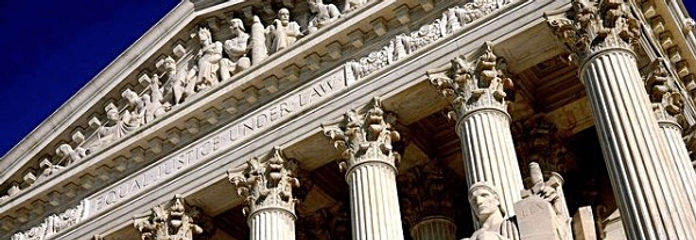

Webinar Video: The Fall of Humphrey's Executor: Trump v. Slaughter and the Future of the FTC

Updated: 25 minutes ago
On June 29, 2026, a divided Supreme Court overruled Humphrey’s Executor v. United States (1935) and held that Congress may not shield Federal Trade Commissioners from removal by the President. Writing for a 6–3 majority in Trump v. Slaughter, Chief Justice Roberts concluded that officials who wield executive power must answer to the elected executive, and left no doubt about the fate of the ninety-one-year-old precedent: “If anything more is left of Humphrey’s, we overrule it.”
The ruling caps a fifteen-year line of removal-power cases running through Free Enterprise Fund v. PCAOB (2010), Seila Law v. CFPB (2020) and Collins v. Yellen (2021). Its reach extends well beyond the FTC, which enforces roughly eighty statutes, to some two dozen multimember commissions long assumed to operate at arm’s length from the White House. Justice Gorsuch’s concurrence pressed the harder question the majority left open: at-will removal does not eliminate the “fourth branch’s” combined legislative and judicial powers so much as reassign them to the President.
On July 2, 2026, the Committee for Justice hosted a virtual panel examining what Slaughter means for the separation of powers, the future of agency independence, and the day-to-day governance of the FTC. Former FTC Commissioner Joshua Wright addressed the decision’s consequences for the Commission and the future of antitrust enforcement, and the Manhattan Institute’s Ilya Shapiro addressed the constitutional stakes for Article II and the administrative state.
Speakers
Joshua D. Wright
Former Commissioner, Federal Trade Commission; Founder, Lodestar Law & Economics; Senior Counsel, Burke Law Group
Ilya Shapiro
Senior Fellow and Director of Constitutional Studies, Manhattan Institute; Contributing Editor, City Journal
Ashley Baker (Moderator)
Executive Director, The Committee for Justice
Transcript
Ashley Baker: Good afternoon, and welcome to the Committee for Justice’s virtual panel discussion, “The Fall of Humphrey’s Executor: Trump v. Slaughter and the Future of the FTC.” I am your host, Ashley Baker, and I’m the Executive Director of the Committee for Justice. I will now introduce our panelists.
Ilya, who is, as you can see, driving here from Baltimore and dedicated enough to still be able to join this panel, is a Senior Fellow and Director of Constitutional Studies at the Manhattan Institute and a contributing editor of City Journal. He previously served as Executive Director of the Georgetown Center for the Constitution and Vice President of the Cato Institute. He is the author of Lawless: The Miseducation of America’s Elites and Supreme Disorder: Judicial Nominations and the Politics of America’s Highest Court, and he edited 11 volumes of the Cato Supreme Court Review. A leading voice on constitutional law and the Supreme Court, he has testified many times before Congress and filed more than 500 amicus briefs with the Court. He clerked for Judge E. Grady Jolly of the U.S. Court of Appeals for the Fifth Circuit and holds a bachelor’s from Princeton University, a master’s in science from the London School of Economics, and a JD from the University of Chicago Law School.
Josh Wright is the founder of Lodestar Law and Economics, senior counsel at Burke Law Group, and a former Commissioner of the Federal Trade Commission. He represents clients in high-stakes state and federal antitrust and consumer protection matters. A leading scholar in antitrust law, regulation, economics, and consumer protection, he has published more than 100 articles and book chapters, co-authored a leading antitrust casebook, ranks among the most cited antitrust scholars in the world, and received the 2014 Federalist Society Paul M. Bator Award for his scholarship and public impact. Josh was previously a professor of law at Scalia Law School for 20 years, where he also served as executive director of the Global Antitrust Institute and taught antitrust principles to hundreds of federal and state judges. He clerked for Judge James V. Selna of the Central District of California after earning a JD and a PhD in economics from the University of California, Los Angeles.
Following our panel discussion, we’ll open up the floor to Q&A, time permitting. If you have questions you’d like to send me during the panel, go ahead and send them to me through the Q&A function on Zoom, if that would be easier for you, and I will then read them toward the end.
I’m going to start with Ilya, if that’s okay, given your driving predicament. My first question is this: the Court did not just narrow Humphrey’s Executor, it overruled it outright, with the Chief Justice writing, “If anything more is left of Humphrey’s, we overrule it.” For an audience that doesn’t live in administrative law, what did the Court actually decide, and why is this firing case one of the most consequential separation-of-powers rulings in decades?
Ilya Shapiro: Yeah, that’s a good question, and I’m glad to be with you. Sometimes you’re asked for the inside-the-Beltway perspective, sometimes the outside-the-Beltway perspective. I’m going to give you the on-the-Beltway perspective right here. And the answer is that we have all of these so-called independent agencies — the alphabet agencies, we also know them as. Here it’s the FTC, the Federal Trade Commission, but the FCC, the SEC, the NLRB — it goes on and on and on. These were created largely during the New Deal as enforcement agencies of the new, growing regulatory, administrative state. And they were designed to be insulated from presidential control because they were supposed to be the experts, the kind of scientific administration of governance.
Well, whatever they were in the ’30s, now they certainly are an arm of presidential decision-making and policy agenda, or at least should be, because otherwise they’re somewhere, I don’t know, in equipoise between the legislative, executive, and judicial branches — the fourth branch, who knows? In other words, if they’re not controllable directly by one of these branches, then they’re unconstitutional.
And so what the Court did here is say the president has to be able to control these agencies, has to be able to remove and staff them with — personnel is policy — his preferred people. This didn’t come out of the blue. There were about 15 to 20 years of cases where they’ve been incrementally chipping away at this, and they finally said, look, Humphrey’s Executor, this 90-year-old case, was an anomaly. We are now going to give direct presidential control, so if the FTC does something you don’t like, you can absolutely directly blame the president.
Ashley Baker: Thank you for that, Ilya. Be careful — you’re making me nervous over here. Okay, Josh, I’m going to turn to you next. Since you sat on the Commission: before Slaughter, how independent was the FTC in practice? And does at-will removal change something real, or does it just formalize a practice that kind of already existed?
Joshua Wright: Yeah, and thanks for having me. I guess that makes mine — I’m out in McLean — the inside-the-Beltway perspective this time. Some things don’t change here, right? I’ll speak mostly of the FTC, but I think this holds across a bunch of the alphabet agencies. I think one of the things that you’ve seen, certainly within the last 20 years at the FTC, is that these agencies were never, in modern times, truly independent of the White House, of the president, of an administration’s priorities. The idea at these agencies is that you’ve got majority control in the party of the president, and that largely has held over the past 20, 25 years. So cue pictures of Lina Khan standing with Joe Biden as the FTC does rulemaking, or now, with Chairman Ferguson and President Trump.
So, on the one hand, I think the independence of these agencies from the president in particular has long, long been overstated. The administration has had a hand in priority setting and agenda setting for the agencies for a long time. Now, I do think that changing removal has some implications for the agency. At my former agency, I was a minority commissioner, the Republican commissioner during the Obama administration. I think the age of minority commissioners at the FTC is dead, and at the rest of them, I think, is dying. Now, that remains to be seen, but I wouldn’t hold your breath expecting President Trump to appoint Democratic nominees to join the Republicans on the FTC. So I think you now have this new creation of an executive FTC, where it’s going to be all of one party and not the other.
And you see some people react to that change and say, well, if we’ve got one party in charge of an enforcement agency rather than two, what happens? What’s the difference? Well, mileage may vary at other agencies, but we’ve had a live experiment of that in the U.S. DOJ has concurrent jurisdiction over the antitrust laws and runs plainly as an executive agency, so I think we’ve got a pretty good experiment to see what that looks like and what it’s looked like over time. Again, there are some differences. I would like to think minority commissioners add some value to the agency. The challenge for the FTC is going to be: how do we adapt to a world where we’re operating without minority commissioners, so that we can replicate some of that function, whether it’s sharpening arguments in cases or what have you?
I’m sure we’ll talk about the practical, in-the-weeds implications for the FTC later, but I think the short version is that the agencies were never independent, for starters. But I do think that changing the removal structure has some implications for the agency and how they operate, and some challenges for the FTC and other agencies moving forward, to replicate some of the value that minority commissioners created within the agency over time. That argument can be overstated, but I do think there’s something there.
Ashley Baker: I’m going to jump in here with a follow-up for Josh. This was also something sent to me beforehand as part of Q&A: What do you think this means for Trump’s pending Republican nominee to replace Melissa Holyoak? What do you think that means for his confirmation?
Joshua Wright: That’s a great question. I imagine that confirmation’s going to be a tough row to hoe. In the old days — when I was awaiting confirmation — it was: trade my confirmation as a Republican nominee during a Democratic administration for a bunch of Dem noms at other parts of the alphabet, right? Those trades are dead or dying. So I think that’s one challenge in terms of the political fight.
The other is, I imagine there’s not going to be a lot of mood to put more Republicans on. Now, they’ve got two, and that’s fine, but when and if we get down to one, and the FTC really needs to put on other noms, I do think it’s going to raise the stakes of some of the regulatory noms, now that some of the trading that naturally arises out of needing to do noms from both parties at the regulatory agencies — I suspect regulatory noms start looking a lot more like judicial noms.
Ashley Baker: My next question I have marked for Ilya, but feel free to opine here, Josh, as well. Humphrey’s rested on the premise that the FTC was, quote-unquote, “quasi-legislative” and “quasi-judicial” and not executive. The Slaughter opinion calls this almost fictional. Was Humphrey’s wrong the day it was decided in 1935, or did it become wrong as the agencies grew?
Ilya Shapiro: I don’t know that much about the historical practice of the FTC as it compares to now. Josh should hopefully know more about that. But it seems like if you’re talking about promulgating rules, that looks like a legislative function. And that function has only grown as the ratio of regulation to legislation has increased in the modern age. So regardless of the answer to that question, which is an interesting academic one, I think it’s hard to avoid the conclusion that a lot of what the FTC does is create laws — effectively, rules by which we live our lives.
But doesn’t that mean that Humphrey’s is even stronger today than it would be then? On that logical point, perhaps. But at the end of the day, these are enforcement mechanisms, rules that the executive is putting in, acting in a prosecutorial function and all of that. So you have to house it in one branch or another, and it’s much closer to executive than anything else.
Joshua Wright: Yeah, I’ll just add — well, I’m glad Ilya called that an interesting academic question, because it’s one I’m working on right now. And it’s purely academic now, for kicks, to describe what the FTC was doing then versus now. There’s been some other really good work on that topic because of the implications for Humphrey’s. But suffice it to say, I think the answer to “Was it wrong the day that it was decided?” is yes. I think it is an unequivocal yes. By the Court’s description in its opinion in Slaughter of what’s executive, or executive enough, the FTC in 1935 and in the years leading up to Humphrey’s was plenty executive. It was doing administrative adjudication.
Now, with the amount of rulemaking, enforcement, heading to federal court — I mean, it’s obviously more executive now than it was then, and I don’t think that there’s any doubt about that, and that’s been true for some time. But my own view on that question is, if you look closely at the day-to-day business of the FTC in the ’20s and ’30s, it was plenty executive then. So I was glad to see the description as almost fictional — the idea that the FTC was not exercising any executive power back then. It was, too, and plenty more now, but it was then.
Ashley Baker: I have a related question, and this can be for either of you. This is about Justice Gorsuch’s concurrence, which I thought was interesting. His concurrence makes a pointed observation: it says that overruling Humphrey’s doesn’t eliminate the fourth branch’s powers, it reassigns them to the president. If the deeper problem is agencies that legislate and adjudicate at once, does Slaughter solve that, or does it just relocate it? How does this play into the bigger picture?
Ilya Shapiro: I think Gorsuch is right. This goes to the whole issue of unitary executive theory more broadly, which speaks to control of the executive branch, not its scope. Just because we get the separation of powers right doesn’t mean we get the powers right. So that is Gorsuch foreshadowing — whether normatively or hopefully or what have you — that he hopes that, whether through the major questions doctrine or nondelegation or other mechanisms, we start grappling with the growth of the administrative state, even if it’s under presidential control.
Ashley Baker: [Inaudible.]
Joshua Wright: Couldn’t have said it better, so I won’t try.
Ashley Baker: Okay. Another related question: in some commentary, this is called a vindication of Justice Scalia’s lone dissent in Morrison v. Olson. Is that fair? And what’s the through line from Free Enterprise Fund, which we saw in 2010, and Seila Law in 2020, and Collins v. Yellen, to here? We’ve seen this natural progression of these opinions on what is a quintessentially executive function. Can you elaborate a little bit more on how we got from those decisions to now?
Ilya Shapiro: Is that to me?
Ashley Baker: Either.
Ilya Shapiro: Well, all of those cases dealt with presidential appointments and removals to various kinds of alphabet bodies. This isn’t the only area in which the Court has acted incrementally. That’s John Roberts’s preferred M.O. And it seemed to be going that way, and really it was with the new constellation of the Court, and especially the Trump appointees, who all kind of made their bones on administrative law and were selected for that as much as for anything else, that it became clear that in the right case, they were going to overturn Humphrey’s. This is possibly the least surprising big case that we’ve had in recent years.
Joshua Wright: That sounds right to me. I think the lesson on the through line in those cases is that we were incrementally moving this way for a long time. I think “least surprising” is exactly right. And as we said, there are lots of issues still on the table, so I think you’re going to see a lot of the intellectual energy turn to some of the issues that Justice Gorsuch rightly pointed out remain on the table. But I think that through line was steady — not as fast as some would have liked, but we got there.
Ashley Baker: So I’m going to turn to Josh now for a couple of questions about the FTC and antitrust enforcement specifically.
Ilya Shapiro: Good, that gives me time to get home to my computer.
Ashley Baker: Exactly. My first question here is: the FTC administers roughly 80 statutes and runs both a competition and a consumer protection mission. Practically speaking, what does the President’s removal power change about how the Commission sets its enforcement priorities?
Joshua Wright: Yeah, so I think this is a question about what you think the value of minority commissioners is. Because, like I said in the beginning, agency chairmen have been in line with presidential priorities for a long time. They are selected to do so, right? Whether it’s Chairman Ferguson, or Lina, or what have you — Chairwoman Ramirez, when I was at the Commission — for a very long time, I don’t think that there’s been a gap between agency priorities, so long as they’ve got the majority, and they almost always do, except for small, transitory periods of time, and presidential priorities. So in that sense, I think there’s nothing new.
What changes with removal is on the minority side. I think in the new executive FTC world, the difference is minority commissioners are dead. So your view on what that means for the agency really depends on what you think the value of minority commissioners is. Having been one, I have views on that, and they go something like this. If you read all of the foundation and theory and promise of these expert agencies — we’re going to put in a bunch of experts, and they’re going to be bipartisan, and it’s going to sharpen the work product, and so forth and so on — that’s really not been the history of the FTC. Certainly some experts in appointments, but just like all of the other alphabet agencies, there’s a really broad trend toward appointment of mostly congressional Hill staffers to fill these spots, and that’s not an FTC thing, that’s an everywhere thing.
In terms of the value of what the minority commissioners actually produce at the agency, take the FTC. The number of 3–2 decisions for the majority over time has increased exponentially. That’s partially polarization of politics around antitrust, but it didn’t start yesterday, it didn’t start with Lina. It’s been increasing dramatically over time, and I suspect that’s true at a bunch of the agencies — the FCC, the SEC — where you get more politically polarized voting.
There is some room for the minority commissioners to improve the work product at the agency. The example I would give from my own stint is the UMC statement. The agency hadn’t put out guidance on what its core unfair methods of competition authority meant in 100 years. When I showed up at the agency, in my very first meeting with Chairwoman Ramirez, she said, “What do you want to do?” I said, “I want to do a UMC statement,” and she said, “Over my dead body.” She said it more nicely than that, but she said, “We absolutely will not do that.” Three years later, we did it, and we did it through political pressure. I must have given a gazillion speeches on Section 5, trying to bang the drum and get the agency to do it, and we ultimately did. That never happens without minority commissioners being present.
You look at the FCC — I think the best model for a valuable minority commissioner, probably in the last century, is Ajit Pai. Unlike the FTC, the FCC had judicial review of a lot more material, right? So Ajit, as Commissioner Pai, got to write dissents everywhere that became models for decisions that went up through the appellate courts, and really produced a lot of value out of the minority commissioner role. I love both of those examples, but they are absolutely outliers. They are exceptions. And I think in the modern world of the FTC or the FCC, mostly what you get out of minority commissioners — we see plenty of 3–2 votes. None of that changes by removing them. I’m not sure you see what the promise was of having minority commissioners whose presence is there to sharpen the work product and improve the decision-making of the agency as a whole. We just have louder 3–2 fights now.
Now, I do think — and I’ve written this elsewhere — that an FTC without minority commissioners faces really two problems. One is, to the extent that there’s real value, a positive marginal product of minority commissioners who are expert, you’ve got to replicate that inside the agency, right? If Chairman Ferguson wanted to do that tomorrow, he could put together a panel of people who have a different ideological view to think critically about decisions and red-team them. I think I’ve proposed something like that to replicate the function of minority commissioners. He could probably do better than minority commissioners, who operate with some political constraints.
The second challenge, and this is a big one for the FTC, is that if you’re going to operate the executive FTC without minority commissioners, you can’t get 30 seconds into that conversation with an antitrust lawyer before they say, “Well, what do we need the FTC for? We have another executive agency, the DOJ Antitrust Division, doing the enforcement of the antitrust laws. Why do we need two?” Right? The idea was we had all these special properties in the FTC, and so maybe it was a little bit different. It’s not. So I think the FTC in coming years is going to have to address dead-on the question — and it gets raised; we have the One Agency Act every couple of years, the Antitrust Modernization Commission says, why don’t we get rid of one of them? This is a perennial antitrust question.
But I think this really puts it front and center. I think the FTC is going to face a little bit more of a direct line of questioning on: if we’ve got two executive antitrust agencies that largely look the same and do the same, why do we need them both? Why not do something like move the competition authority to DOJ, have the FTC, and remove the common carrier — those are questions that I think got bigger after the Slaughter decision. And I think, both for Chairman Ferguson and as the FTC moves forward, those are questions that are going to become bigger on the antitrust front.
Ashley Baker: And that’s kind of — I’m going to combine some of the other questions into a follow-up. I do wonder what exactly this means for antitrust enforcement in the courts. We see a lot of these cases reach the Court of Appeals. We saw this happen under Lina Khan’s FTC, with the Illumina/Grail case, with the Microsoft case. We saw a lot of questions in the Court of Appeals that got to the root of FTC authority. This seems like it could potentially be a double-edged sword, too, in terms of what judges will make of these swinging enforcement priorities when there’s no continuity here. And there’s kind of a counterargument, too, that I won’t get into here, but how do you think this could play out in the courts?
Joshua Wright: It’s a great question, and my first reaction is, for all the talk of volatility and swinging around of the agencies from administration to administration, the most stable body on antitrust law in the world has been the United States Supreme Court — in its view of the consumer welfare standard generally, but also in the way that it approaches antitrust decisions. Maybe you get a little bit more volatility in the lower courts, no doubt about that. But I think the question raises an important challenge for the agencies moving forward. I pointed out: how do you replicate inside the agency the role of the minority commissioners if they’re not there? This is a second challenge, which is that bipartisan decisions — like it or not — bipartisan decisions from the FTC to bring cases to federal court get treated a little differently.
You can read them historically. Some of those are in the age where courts granted more deference and the like, but I think there’s some reputational capital earned through bipartisan decisions, and you can draw a line to that through some of the FTC enforcement initiatives over time. What happens without that? I think the challenge to the agencies is now the trade-off. Historically, the courts have played an important role in checking both Republican and Democratic excesses on antitrust enforcement over time, right? They did it with Lina. They did it in the ’70s. They’ve done it over time with both parties and played a really important constraining role to keep the volatility from swinging too far from side to side. I don’t have any reason to think that that’ll change with the FTC joining the ranks of executive agencies. We see that already now in the treatment of the DOJ.
But I do think there’s a real challenge for the FTC moving forward. Bipartisan decisions and actions of the agencies were a way to build reputational capital and a reputation as a thoughtful, deliberate agency. The FTC earned that over time. It’s done a lot to incinerate it over the last decade. But it earned that reputation over time, and that had some benefit in the courts. If you can’t get bipartisan decisions anymore because they don’t exist, where does that reputational capital come from? I would be thinking hard, were I running the FTC, about other ways to go out and build that reputation, whether it is through research and studies, like the FTC used to do more of.
That reputational capital is a pretty valuable asset for that agency. I do think we’ve cut off one way for it to invest in that capital, and I do think it’ll be a real challenge to find alternative ways. They’re out there, but they’re longer-term projects, right? You’re a new chair; the short-term political goals are to bring these cases and do this right away. Who wants to invest in taking two years to do new merger guidelines, or doing studies that take two years to get the data and publish? It takes a longer-term view, and relative to yesterday, I think the rate of return on those activities went up, and I’d expect to see some adjustment along those lines by the FTC moving forward.
Ashley Baker: My next question — and I’ll turn it back to Ilya; thank you for rejoining us — is this: this ruling touched on something like two dozen multi-member agencies, such as the NLRB, the FEC, the SEC, FERC, et cetera. What spills over the most? And does any independent structure really survive the Slaughter opinion fully intact — and I don’t mean the agency itself, but its day-to-day operations, what Josh was just talking about in terms of the courts and in terms of nominations? What’s the real impact on other agencies?
Ilya Shapiro: Well, the logic applies to all agencies. I’m curious about those that are statutorily required to be balanced. The FEC comes to mind: no party is supposed to have a majority. But if some member rolls off, then a party can’t have a majority, for practical purposes. So historically, nominations have been done in pairs, and maybe that stops now? Unclear. Can the president indeed fire Democratic members — or members of the opposite party, right, because it’s not just the current president — and not replace them at all? Thereby, even though the statute says what it says, and even though there’s not a majority appointed by one party, there are vacancies, so in effect you do have a majority. So that could shift the dynamic in those agencies.
Ashley Baker: Josh, do you have anything to add there?
Joshua Wright: I don’t. I didn’t catch the last five seconds of it — I’ve got a little internet blip — so no, I don’t.
Ashley Baker: So, along that line, the Court in the decision kind of spared the Federal Reserve —
Ilya Shapiro: One other comment on that, Ashley, though: the agency actually does have to be exercising executive power. Another agency that is often mentioned when you’re thinking of statutory partisan balance is the Civil Rights Commission, but that commission doesn’t have any enforcement powers. It holds hearings and issues reports, but it’s effectively an advisory council to Congress, to whomever. So it could well be that Humphrey’s doesn’t apply to the Civil Rights Commission or any others that similarly don’t actually have any power.
Ashley Baker: That would make sense. And speaking of agencies that it doesn’t really apply to — that the opinion spared, or that Cook spared — my next question is for either or both of you. The Court spared the Federal Reserve as, quote-unquote, “a uniquely structured, quasi-private historical exception,” and reserved the Tax Court and the Court of Federal Claims, it said, for another day. What do you make of the Fed carve-out? Is that a principled carve-out, or is this where the next round of litigation begins, do you think?
Joshua Wright: I’m happy to go first. I think it’s a tough question. I think yes to both, so I’m going to delete the “or” in the question. Is it the next round of litigation? You betcha. Is it a principled distinction? I’m no Federal Reserve Board expert, but my first reaction is that the intellectual gymnastics for that carve-out are impressive. But I’m not sure if they’re both impressive and principled.
Ilya Shapiro: So, a few things here. First of all, the litigation in Cook itself continues on a fact-finding basis to see whether there is cause, and that’ll get litigated and might come up to the Supreme Court again on that question: what is “for cause”? They might have to resolve that. Secondly, I agree with the procedural dissents, at least, of both Barrett and Alito and Gorsuch in Cook, in saying that the Court should have just granted or denied the stay back in the fall and been done with it, rather than having this whole rigmarole and being back to the start of it, remanding for fact-finding in the district court.
And third, there is a difference between the Fed and these New Deal–era enforcement agencies. Monetary policy is different than what the FTC does, what all these alphabet agencies do. Is it different enough? Does it even matter, because it’s still an independent agency, and we’re still not allowed to have a fourth branch of government? I don’t know. There’s a very salient point, I think, that Roberts makes in his opinion: that even at the founding, even Alexander Hamilton, who was no slouch on executive power, was concerned about political manipulation of monetary policy, and the examples of the First Bank of the U.S. and the Second Bank of the U.S.
But query — as one of the dissents points out, a lot of the functions that the Fed has now are different than what it had 50 years ago, let alone at the time of the founding. So just a blanket sweep of everything the Fed does might not quite be right, although it could be that at least some of the Fed, the core monetary policy bit, there is a principled way of explicating that. Maybe they didn’t do it fully because this is just an interim relief order. But I think the issue’s going to return.
Ashley Baker: I think that sounds about right. My next question, for both of you, is about Justice Sotomayor’s dissent. In her dissent — she dissented from the bench — she warned that the decision hands the President a power unknown even to the English crown and invites only chaos. What’s the strongest version of a critique to that? What’s your answer to her dissent?
Joshua Wright: I mean, again, I view this mostly through an antitrust lens, because that’s the neighborhood I play in, but the President just fired the head of an antitrust agency. Gail Slater was terminated, or resigned in the face of termination, et cetera. We’ve not had chaos at the DOJ Antitrust Division. People can like or dislike the direction of the policies, but those are debates that happen all the time. Those were debates that happened when Jon Kanter was there in the Biden administration, and nobody was firing him. So we’ve had —
Ilya Shapiro: I’ll answer it more sharply. Surely, as powerful as any of these agencies are, FTC or otherwise, they’re not as powerful as the Department of War or the Department of Justice, and the President can fire the heads of those. Nobody disputes that. So the question isn’t, is the president becoming all-powerful? He’s had these powers. The question is, if these agencies are executive branch agencies, then they have to report to the president, and if they’re not, well, which branch are they in? That’s what this ultimately comes down to. It’s about making them into proper — whether they’re called cabinet or otherwise — executive agencies.
Joshua Wright: I think that’s right. With us fighting this on the turf of the FTC, there’s just empirical evidence about the invitation: we haven’t got the chaos, right? We’ve had two Republican commissioners after the Democrats got fired for a long time now. We’ve lived in the antitrust world with an executive agency doing half the work for a really long time. We know what that looks like. I think it’s hard to take the chaos point seriously when we’ve lived in that world for quite some time without seeing the parade of horribles that Justice Sotomayor promises.
Ashley Baker: I mean, really, what is the chaos point when this literally points back to Article II of the Constitution? I think a lot of that is kind of lost on the public — the constitutional aspects of this issue.
I’m going to skip around a little bit to the Q&A, which skips around a bit, but I think there are some questions in here, some of which we’ve answered, some of which are worth answering. The first of which is: How much does the Slaughter opinion rely on Chief Justice Taft’s holding in Myers? Has Myers been restored to its place as a good overview of the unitary executive being a fundamental part of the Constitution?
Ilya Shapiro: I think it’s a vindication of Myers. If you overturn Humphrey’s, then by definition, to the extent to which Humphrey’s overturned, cabined, or restricted Myers, Myers springs back. It’s obviously discussed a fair bit — however much it is in John Roberts’s mind, which is a fair bit, if you read the opinion — but just as a matter of basic operating principle, Myers is fully good law. If it had a red flag, or probably had a red flag, but even a yellow flag on Westlaw or Lexis, that should now be removed.
Joshua Wright: Yeah, I think that’s an unequivocal yes.
Ashley Baker: I think so, too. Another question here in the Q&A: Gorsuch suggests the question may not be that the president gets authority over non-executive actions of independent agencies. Therefore, will the nondelegation doctrine become more important?
Ilya Shapiro: Oh, la la — I hope. Things were pointing toward it being more important, but then it was rejected in a non-sexy case involving fees on cell phone bills, Consumers’ Research, from last term. So maybe there’s not a majority interest in it, but it’s going to keep coming, because unless they’re going to run everything through the major questions doctrine, which may well be the case, it’s as Gorsuch described in his Gundy dissent: there are these hydraulic forces. So whatever you call it, you’re going to have to grapple with this issue. If you are interested, which the Court seems to be, in making Congress great again, you’re going to have to grapple with these delegation issues.
Ashley Baker: You mean there are non-sexy cases involving consumer protection?
Ilya Shapiro: Not as sexy as transgender bathroom access and the like.
Ashley Baker: Fair enough. Okay, we’ll move on to another audience question. Is there some value to having minority commissioners? I think we’ve partially already touched on this, but: Is there some value to having minority commissioners from either party publishing dissenting judgments to hold the majority to account for their decisions and offer a counterpoint? Or is it largely a virtue-signaling exercise, since these critiques can always be published externally?
Joshua Wright: Well —
Ashley Baker: We didn’t answer that second half of that question.
Joshua Wright: Yeah, I feel like that question is pointed at me. So look, I believe I still have the record for dissents at the FTC. In fact, I know I still do. So is some of it virtue signaling? You bet, I’ll plead guilty. But the truth is, I do think that there is value. There is more when the dissent is from decisions that are going up for judicial review, right? You have a straight line to some sort of mechanism to alter the path of the agency. And the FTC just has less of that, right? Most of what it does is in consents, either in consumer protection or competition, and the dissents aren’t up for review.
So 80 percent of the dissents — certainly 80 percent of mine — were about consents, and I think there is an important, valuable function in those. You get to tee up lots of issues for debate, or point out changes in FTC practice, a lot of which happens through consents — to tee up issues for public debate, to set the stage for a later commission. And I think you can point to lots of examples where minority commissioner dissents did exactly that.
Now, I think the right question is: compared to what? And I think the questioner in the Q&A may have had that in mind. Can you replicate that function elsewhere? Academics do that, commentators do that, practitioners do that. So what’s the extra value you get out of having a minority commissioner do it? And how often do they do it? I think the truth of the matter is, if you look at FTC history, there are some important dissents, there are some dissents that stage debate or change the course of agency decision-making, but there are not a lot. There are a handful.
And if you compare — we have a nice little natural experiment on antitrust, not in consumer protection, because you’ve got the DOJ operating, obviously, without published minority dissents, but lots of eyes on it, right? Lots of debate over DOJ policy and enforcement decisions that tried to hold it accountable. Really, in running a horse race between internal and external sources of accountability, which has the comparative advantage? I think it’s a pretty open question. But from casual empiricism — and it hurts my feelings to say this as a minority commissioner who spent a lot of time trying to hold the majority accountable — the number of instances in which you can successfully point to something a minority commissioner could have done that couldn’t be done externally, I can think of a handful. I can think of three, probably.
But that’ll be new for the agencies, right? I think they’re going to see more external accountability, and they’ll have to be ready for that. It’s going to look a lot more like the DOJ. You’re going to see a lot more external rather than internal accountability. And I think if the FTC were playing this smart — not all accountability takes place in dissents. There’s also inside-the-building accountability, politics with a lowercase p, that happens between majority and minority commissioners on individual matters of policy direction, et cetera. That doesn’t get seen very often, but it’s a pretty important role that minority commissioners can play.
And if I were the FTC majority at the new executive FTC, I would be thinking really hard about how to replicate that. I’d be thinking really hard about how to do something internal that helps me see around corners, that helps me understand the arguments the other side will be making, from sources more than agency staff. I think that’s an important thing that the agency ought to do.
Ashley Baker: I have another question that I received for Q&A via email. Either of you can answer this, but I think this may be a little bit more directed toward Josh. From a practical standpoint, will it be harder for presidents to recruit qualified nominees to serve as FTC commissioners if they know that their service has a high chance of ending when the president is no longer in office? If so, how significant of an issue is this?
Joshua Wright: Not very, mostly because of the practice. People leave fairly often right now when the White House changes hands anyway, as they discuss in the opinion, right? So Lina leaves when President Trump wins. That’s been the custom. Now, it’s only a custom, right? It’d be more than a custom now. We had to worry about holdovers and deadlock votes and the like, and that’s something around election time that gets a lot of attention at the FTC, because you drop to an even number for a while and have stalemates, and everything changes.
For the antitrust people who are tuning in or listening, this was the Qualcomm dilemma for a long time. Tied 2–2, couldn’t settle, couldn’t close, couldn’t do anything but let the FTC litigate, even when the case ran afoul of the priorities of the administration. So you see less of that. I think that’s a good thing, right? The administration couldn’t touch its own case for a year. That’s bananas.
Now, what does that mean for appointments? I don’t really think that there’s much of an issue in, “Hey, I know I can only be here three or four years.” I think the average stint is around three or four years. You don’t get many who stay the full seven — Bill Kovacic, maybe? But beyond that, you don’t see that too often anymore, so I don’t think that’s too much of a factor.
Ashley Baker: Fair enough. Another question for both of you — you can spend as much time on this as you’d like. Looking forward, what should the audience watch for over the next 12 months as this decision gets operationalized, in terms of FTC operations, but also in terms of future litigation and what’s the next issue for the courts to tackle?
Joshua Wright: Go ahead, Ilya.
Ilya Shapiro: I think the Fed stuff’s going to come back before the next issue in this line. This is sort of the apogee of the removal and appointment stuff, so now we move on to substance.
Joshua Wright: Yeah, and then from the FTC perspective, look, should we go down to one commissioner? Noms are going to get trickier at the FTC. It’s higher stakes. I think from the Dem side right now, putting in more Republicans after having the minority commissioners fired — I doubt anybody’s in the mood. Now, this was already happening, but I think that you’re going to see regulatory noms look a lot more like judicial noms, with a lot more party-line votes all the way through.
Rewind 10 years. When I went up during the Obama administration, I think Senator Barbara Boxer said I was the most right-wing thing ever to touch the inside of the agency, or something like that. And I went through unanimously, with lots of finger-wagging and statements — “I didn’t want to do this” — but I went through unanimously. Fast forward 10 years, and I don’t think you could get anyone through unanimously.
Ilya Shapiro: Is that just because you were a squish, though, Josh?
Joshua Wright: Maybe so, maybe so. We’ll let history judge. But I think if you look now, you’ve got party-line votes all the way through on people who have some bipartisan appeal, right? Like some of the modern Republicans some of the Dems like, because they’re much more active on antitrust, or they have a big appetite to go after Big Tech, or what have you. There’s a little bipartisan joining around the edges of some of those issues, and those guys are still going through with 40-plus no votes. I think it’s only going to get more contentious because of this — because you don’t have minority commissioners to moderate any of the actions of the majority, and because people are a little pissed off about the firings, right? I expect that’ll last for a little while, and it’ll be harder to do business for regulatory noms, also because of the trading point we made. There’s less of a bartering system available.
So what do you get for putting in the third executive FTC Republican? What’s in it for the Dems? I think it gets harder for noms. That may, to the last Q&A question, [matter] more than the possibility of having to resign or be fired if the White House changes over. If you ask people, “Hey, do you want to go through a really nasty, contentious nomination and confirmation process?” a lot of hands go down. I think that’s probably the bigger issue, and I think it predicts more of the same, really — more political-operative sort of people who are signing up for that process, and fewer practitioners, academics, and the like.
Ashley Baker: In closing — we only have a couple of minutes here, and I know it’s been a really long week for those of us who work on the Supreme Court — any closing remarks? Anything else that you’d like to add?
Joshua Wright: I’ll say briefly: glad to see this. This is good for the world. I think it’s good for the world for —
Ashley Baker: Good for the world. This is our takeaway. I like it.
Joshua Wright: Good for the world, and some complicated things to work out within my little antitrust and consumer protection world, and, I suspect, lots of the alphabet agencies. Some complicated things to work out, and some changes in the way people strategically interact with the agency, or the agency interacts with them. Some complicated things to work out, but good for the world.
Ilya Shapiro: I wrote up a piece for City Journal that got published on Tuesday — God, that was four op-eds ago already — on the case, so I think I had my big takeaways there. It was called “Humphrey’s Executor Has Been Slaughtered,” so that’s the key pun takeaway from this. But that’s about it.
Ashley Baker: Okay, great. Thank you both for attending, and thank you to our audience for joining today. This will be posted online in the coming days, after we all get a little bit of a breather here. And thank you to both of our panelists for joining us on this afternoon before the holiday of the Fourth. Have a good weekend, and happy America 250 to everyone. Bye.


